
What it is for
Tool selection, deployment, and provisioning is the tractable part of AI adoption. The decisions that take longer to surface, and carry more consequence, are different in kind: what am I actually trying to accomplish with AI? Where am I actually operating today? What is needed to unlock the next step? And what must I choose to keep human?
The HumanAI Framework was developed to answer those questions precisely, for individuals, teams, and organisations. It is built around three interlocking structures: five adoption scopes, five operating domains, and four shift enablers. Each one is diagnostic before it is prescriptive.
Five scopes of adoption
The scopes describe how AI is being used, not what AI tools are in play. The scope is defined by the human relationship to the technology, not the technology itself.
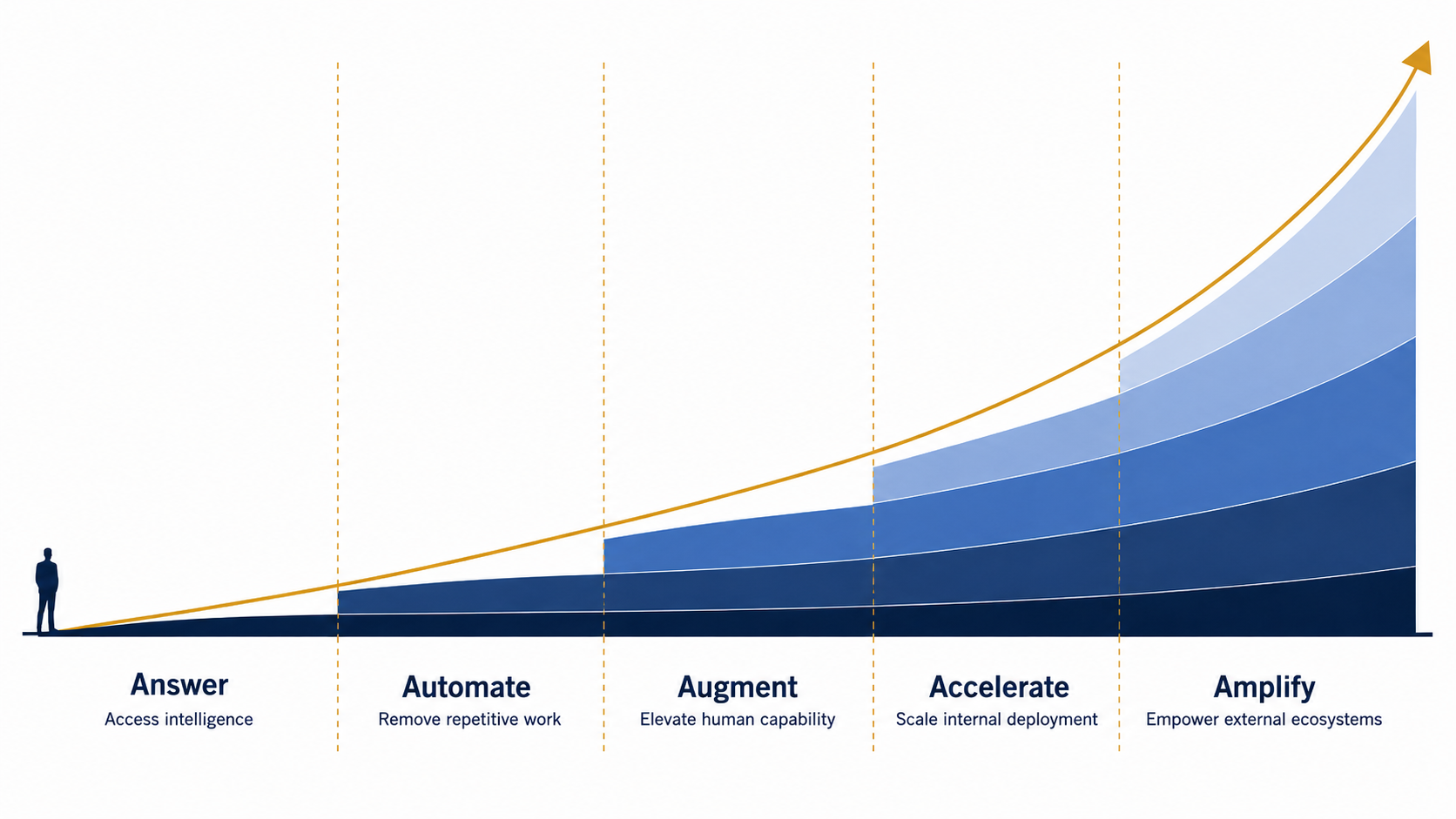
1. Answer
Objective: access intelligence.
AI as an on-demand, conversational knowledge interface. Interactions are most notably one-off and human-initiated. Done well, these interactions significantly raise the capability floor. The characteristic trap is treating AI as an oracle rather than a thinking partner.
2. Automate
Objective: remove repetitive work.
AI connected to tasks and workflows, operating without per-task human initiation. Time is reclaimed and volume barriers dissolve. The characteristic trap is automating broken processes at scale, where speed amplifies flaws.
3. Augment
Objective: elevate human capability.
Human and AI in genuine collaboration, with the human as the locus of judgment but substantively elevated by AI contribution. The output is qualitatively and quantitatively better than either could produce independently. The characteristic trap is mistaking elevated output for elevated wisdom.
4. Accelerate
Objective: scale internal deployment.
AI adoption becomes ingrained in organisational architecture. Multiple functions, standards, governance structures, and tool stacks all actively consider impacts on AI. The organisation is not just using AI; it is becoming AI-first and intentionally choosing what to keep uniquely human. The characteristic trap is deployment breadth masking adoption depth.
5. Amplify
Objective: empower external ecosystems.
AI-powered value flows outward through products, platforms, and services. The organisation is no longer only a consumer of AI; it is a node in a broader ecosystem. The characteristic trap is building amplification on borrowed infrastructure without a strategy for when that infrastructure changes.
The scopes are cumulative, not interchangeable. A gap in an earlier scope is a liability at every higher scope, regardless of performance.
The model incorporates a key inversion at Scope 4, it inverts from "what do we transition to AI?" to "what do we keep human?"
Five operating domains
Across all five scopes, adoption is shaped by five domains. Each domain has its own trajectory, from personal concern to collective responsibility to societal accountability.
People. Who are we becoming in relation to AI, and are we choosing that deliberately? Covers AI literacy, roles, cultural readiness, leadership modelling, and the embedded ethics of dignity and autonomy.
Technology. What are we building on, and is it fit for what we are trying to do? Covers architecture, tooling, infrastructure, integrations, and the decisions about where AI capability is built, bought, or orchestrated.
Data. What do we know, how good is it, who can use it, and what are we generating that will matter tomorrow? Covers data quality, pipelines, knowledge management, proprietary advantage, and the ethics of consent and provenance.
Governance. Who is accountable, for what, and how do we know when something has gone wrong? Framed temporally: audit for the past, compliance for the present, risk for the future.
Security. What could go wrong that we did not invite, and have we made it sufficiently hard? Covers information security, AI-specific threat vectors such as prompt injection, supply chain risk, and the broader stewardship of trust.
Ethics is embedded across all five domains rather than treated as a discrete concern. Embedding ethics structurally is what prevents it from being addressed once and then set aside.
Four shift enablers
Moving between scopes is not a single kind of challenge. Each transition has a specific nature, and the intervention required must match.
| Transition | Enabler | Nature of challenge |
|---|---|---|
| Answer to Automate | Technical Capability | Technical |
| Automate to Augment | Mindset Shift | Psychological |
| Augment to Accelerate | Deployment Breadth | Organisational |
| Accelerate to Amplify | Empower Orientation | Philosophical |
A person or organisation that is stuck is not generically behind. They are blocked by a specific kind of challenge. Throwing technical solutions at a psychological block, or psychological work at an organisational one, produces motion without progress.
The Diagnostic Assessment surfaces which enabler is the active constraint and maps it to the intervention logic required. Precision here is the difference between a practitioner who pattern-matches and one who correctly diagnoses.
How it is used
The Framework is the underlying structure of advisory work at Zentelligence and the AI transformation engagements delivered to enterprise clients. It is equally applicable at any scale: individual professional, solo practitioner, small business, or large organisation.
As a diagnostic tool. The structured assessment places individuals and organisations on the scope ladder, identifies which domains are reinforcing current performance and which are quietly undermining it, and pinpoints the specific nature of the next transition constraint. The result is a precise picture of where you are and what will move you forward.
As an advisory and engagement framework. Each shift enabler requires a specific approach.
If you want to know which scope you are operating at and what is constraining the next step, the clearest starting point is a conversation.